

Abstract
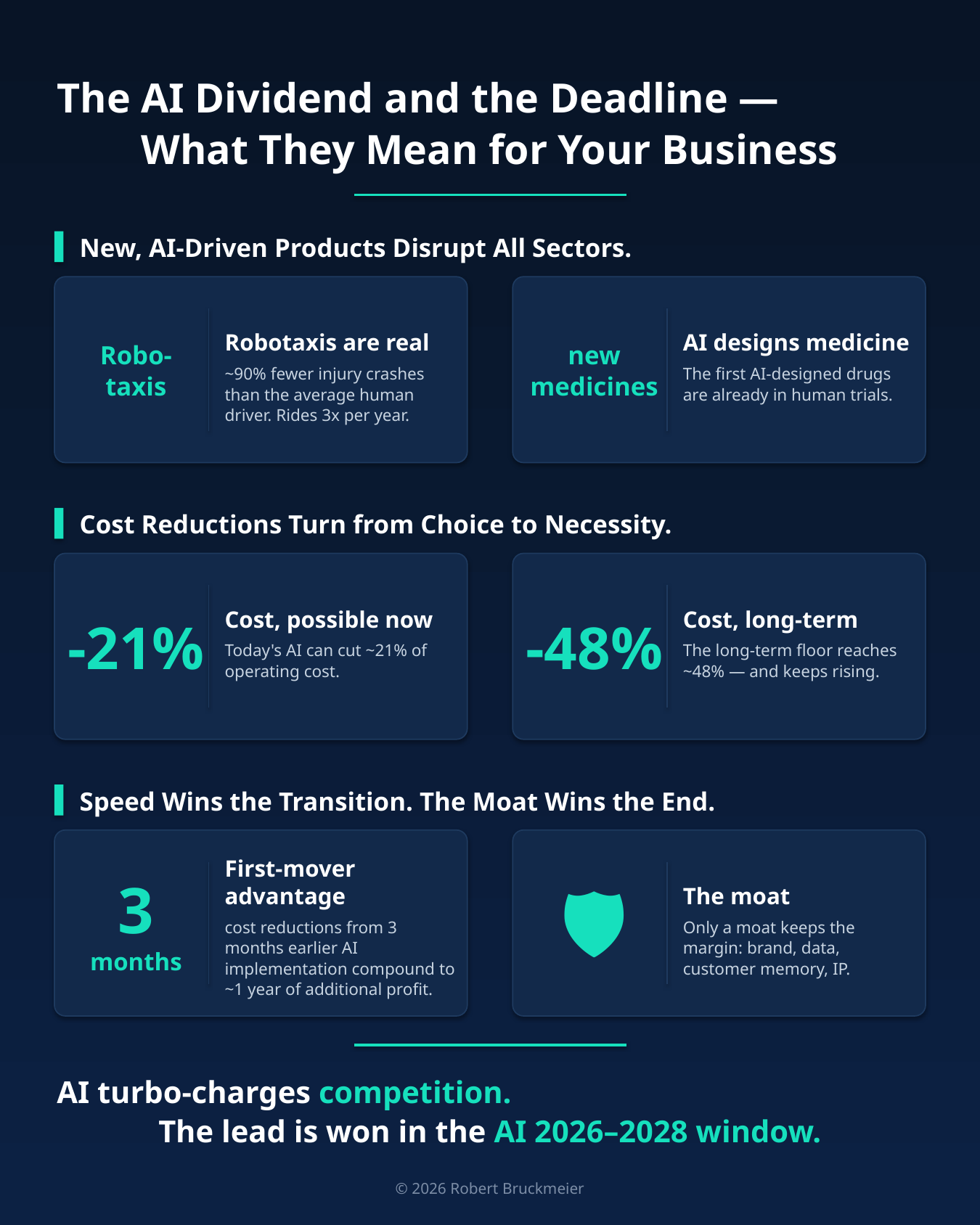
“Practical AGI” (artificial general intelligence) has arrived and deployment is moving from pilot to production among the leaders. Now AI turbo-charges competition: every rival can cut cost and build new products fast. The advantage goes to whoever moves first. The lead is won inside the 2026–2028 window.
For businesses, this is broken down in 6 chapters:
Rebuild business functions AI-first. This resets the cost base every rival competes on: operating cost reductions of ~21% are possible now, rising to ~48% as robotics and agents mature. Start with quick-win copilots that pay back in under a year.
Lead your sector by reinventing the product. The deepest AI gains create products that reshape whole industries: Robotaxi rides triple a year and the first AI-designed medicines reach the clinic. First movers out-innovate faster than rivals can copy. Build deep, narrow AI on your own data, not a generic copilot.
Close the AI implementation gap. The limit is execution, not the AI offering. 88% of firms run AI, yet ~95% of pilots show no profit in six months. Readiness decides the outcome, and mid-market firms can build it. One company AI platform, wired to your data and grading its own output, scales proven wins to return fast.
Compete in the agent-mediated economy: the platform that owns the agent owns the customer, because it holds the customer’s data and context. AI is expected to mediate $20.9B of US retail in 2026. Ensure your best presence in the new agent platforms. Build a direct channel you own, so customer memory stays yours.
Quantify and drive the bottom-line impact. The prize is huge but mostly not the firm’s to keep long term. Competition eventually converts most of the cost reduction into lower prices, and by ~20 years the average firm earns near-zero additional economic profit. Speed wins the transition and justifies early investments. The moat wins the end: brand, proprietary data, customer memory, or patents.
Turn an understanding of the other players into business advantage: the AI firms you buy from, the people you employ and sell to, the governments that set your rules, and the world system. Competition within each player drives AI progress. This compresses a decade of innovation into the next 10 quarters, the remaining 2026–2028 window, where the lead is won.
Get the full paper here as HTML or PDF.
Feedback is highly welcome — leave a comment below.